skip to main |
skip to sidebar
 Upcoming Google Nexus One smart phone consists of shares worth about $ 175, according to a tear down of the iSuppli. The new phone, which Google unveiled, offers a less developed by Google and the external design of HTC. The main interface is a 3.7-inch AMOLED display. The Nexus One runs Google Android operating system 2.1, and WVGA display appeared 3G graphics. While Google has priced at Nexus One at $ 179 with a two-year T-Mobile service plan ($ 529 without the subscription plan), the phone numbers of the material for $ 174.15, according to iSuppli analysis, which was posted Friday. The report stated that his plan does not include other costs such as production, packaging and software. "Things like that durable unibody construction, a blazingly fast Snap Dragon base band processor and bright and sharp Active Matrix Organic Light-emitting Diode (AMOLED) displays all have seen on previous phones, but never before combined in one design," Kevin Keller Senior Specialist in iSuppli, said in a statement. Most animals in the 17-bit in HTC-built phone is 1 GHz Qualcomm Snap Dragon's processor, which rings in at $ 30.50, or 20 percent of plan iSuppli Bill of materials. Snap Dragon debuted in February 2009 in Toshiba TG01, which is based on Windows Mobile. But iSuppli found ARM-based processor to be better in the new Nexus One. The Android 2.1 operating system is used in the Nexus One better capitalizes on fast performance Snap Dragon is, the user interface and applications run very fast, "Keller said." This processing muscle also gives Nexus One key capabilities, especially the high-definition 720p video playback. " Next expensive component is Samsung's 3.7-inch AMOLED display, which lists at $ 23.50. iSuppli notes that the AMOLED technology appears before the Samsung's Android-based I7500 with a 3.2-inch AMOLED touch screen. "The 3.7-inch AMOLED display at Nexus One delivers a stunning picture," Keller said. Rounding out the three most expensive part in the Nexus One is Samsung's 4Gbit (512MB) of DDR DRAM, which costs $ 20.40, or about 11 percent of the estimated cost iSuppli today. iSuppli notes that comparable smart phones generally contain not more than 2Gbits of DRAM, but to increase the memory to allow for better application performance.
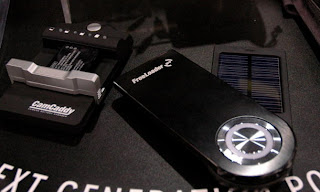 A look at Solar Power International's FreeLoader Pro solar charger shows how these can function as multipurpose chargers that happen to have solar panels.The Freeloader Pro, which will be available in the U.S. starting next week, is a handheld charger made up of two small solar panels and integrated lithium ion battery.Like the dozens of solar chargers on the market, the Freeloader Pro can charge up cell phones, GPS devices, and other small gadgets. What makes it versatile is the accompanying CamCaddy, an adjustable device for charging different sized block batteries for digital cameras, camcorders, or digital SLRs.Generally FreeLoader Pro's battery takes atleast 8hours to juice up by the solar panels (a larger solar array is also available, which will cut charge time to three hours). There's enough charge to run an iPod for 28 hours or 70 hours of standby power for a phone, according to the company. It can also be charged from an AC adapter.Because the Freeloader unit is equipped with a USB port, it can charge various devices. The primary use of the charger is to have portable power for camping or when someone can't get to an outlet. But the company has found that a number of customers are business travelers looking for a trimmed-down way to charge their various gadgets, said CEO Adrian Williams. Instead of carrying dedicated power packs for three or four items, a person could take the Freeloader, USB cables, and adapter tips."We don't way people to buy it because it's green. We want them to buy because it's useful. The green part is an added benefit," he said.What about the battery itself, which over time will wear out? Walker said that, because of EU directives, Solar Power International will take back the Freeloader unit and replace the worn-out battery after two years for about $13. The material in the batteries themselves will be recycled, he said.
 Google is expected to call the new year by unveiling its own smartphone on Tuesday, the connection One, in a bid to expand its powerful brand in the booming web mobile arena.The Internet search and advertising giant has gained the opportunity to market its Android mobile operating system, which featured a phone number beginning with T-Mobile's G1 in October 2008 and more recently Droid from Motorola.But one connection, designed by Taiwanese handset manufacturer HTC, represents a significant departure from that Google is expected to sell Google-branded phone directly to consumers is not tied to any one carrier telecom.Apple's popular iPhone, for example, is only available in the United States by AT & T, but the buyers of the "Google phone" is reportedly their choice of wireless carriers.Technology blog Gizmodo, mentioned in the leaked document, said the connection one is worth 530 dollars, "unlocked" - meaning it is not tied to a specific carrier - or 180 dollars on a two-year service agreement with T-Mobile, a subsidiary of Germany with Deutsche Telekom AG.Google is shy about any plans to go first to the rapidly growing smartphone market, down notes but not showing it in pursuit of illegal.Inquirer and other media outlets have been invited to a press event on Tuesday in the Google headquarters in Mountain View, California, charged only as an "Android press gathering.""By launching the first Android-powered device just over a year ago, we have seen how a strong, open platform could spur mobile products of change," the invitation said. "And this is only the beginning of what is possible."Google provided no additional details about the event, the timing appears to be an attempt to upstage the Consumer Electronics Show, the annual technology extravaganza that opens in Las Vegas on January 7.Among the notes dropped by Google is a blog post last month in which the company said employees of testing is a mobile product in an exercise known in the industry as "dogfooding."Google's plunge in the smartphone market has thought of a mixed reaction."It looks like Google is moving to see if they can do things that Apple," said Rob Enderle ANALYST, the Enderle Group in Silicon Valley, a reference to the iPhone, which has become a wonderful success since it was introduced in 2007.Pointing to Google's 750Mi$ acquisition of mobile advertising company AdMob in November, a number of analysts said Google hopes to replicate its success of Web advertising in the mobile space.Not everyone is convinced by the wisdom of moving. "For Google to go into business selling phone just does not make a whole lot of sense," Gartner ANALYST Van Baker said."Just from a high-end phone you do not really buy much," Baker said. "I'd be hard pressed to have enough revenue from pushing ads to pay for phone service."Ovum research fellow Jonathan Yarmis said Google has to walk a fine line between marketing its own smartphone and being supportive partner for the growing number of companies building their own handsets based on Android.
 A company that makes accessories for cell phone want to add something else to the endless list of things you can do with an iPhone: flying toy helicopter.International Consumer Electronics(ISE) Showed this week, Paris-based Parrot unveiled its AR.Drone - a plastic and foam helicopter was about a foot long and can be controlled remotely from the screen of the iPhone or iPod Touch. Copter The iPhone connects over Wi-Fi and is equipped with two cameras: one on his belly to calculate the speed of this and other of his nose medium in its field of vision back to screen phone.Simulate also plans to release games that meld the real world seen by AR.Drone to "expanded reality." This means that the helicopter may appear from the virtual objects like robots on the screen of the iPhone's.Monkey founder and CEO, Henri Seydoux, thinks the toys will appeal to people because they play it out - something not usually get a video game.Loro expected to release later in the year AR.Drone. It is not announced a price.
 Otterbox is known for its ultraprotective for the iPhone. Now M-Edge, which specializes in cases, the Kindle, does the same for the Kindle, with a report that will sell the first waterproof case Kindle this spring.The company claims that carers are made of molded plastic and protects the Kindle in all environments of water 1 meter deep, whether you're in the pool, ocean, or just a bath. Your e-reader is completely closed, in the case, but you can still access all the buttons for "flexible closed cut button. Even better, the case turns out to inflame the flotation device and allows you to become acquainted with the kit in the water.According to Mr. M-Edge, "The three inner chambers provide buoyancy of the flotation to keep Kindle distributed at sea and vertically in the water reading. Cool.
 surprised to find that the impact of mobile phones, launched in early adult life protects memory in mice otherwise destined to develop symptoms of Alzheimer's disease, "Gary Arendash, lead author of the study and research of Florida Alzheimer's Disease Center, said in a statement.The researchers showed that mice, exposing old Alzheimer's disease in the electromagnetic waves generated by mobile phones removed brain deposits of beta-amyloid, a protein is strongly associated with Alzheimer's disease. Clumps of beta-amyloid form of the so-called brain plaques that are the hallmark of this disease. Scientists suggest the radiation of cell phones increases brain temperature, causing brain cells to release Nasty plaques.They suspect that a similar effect would occur in humans, and therefore mobile phone radiation can be used for prevention and treatment of debilitating diseases for us, they say.However, studies conducted in rodents, does not always lead to a useful human therapy, so further studies will be needed.Mice on cell phones:The study involved 96 mice, most of which have been genetically modified to develop beta-amyloid plaques and memory problems mimicking Alzheimer's disease as they age. Some mice remained as is, so that scientists could test the impact of radiation on normal memory.Both Alzheimer's disease, and mice were exposed to the electromagnetic field generated by the use of standard mobile phone within two 1-hour periods each day for seven to nine months.Mice were actually chatting on a mobile phone or even the packaging devices. Rather, they were placed in cells arranged around a centrally located antenna, which gave rise to a cell phone signal. The cells were located at equal distances from the antenna and is subjected to radiation emitted normally to the mobile phone, pressing a human headRadiation and memory:Was protected results showed, if the impact of mobile phones began when the mice were Alzheimer's young people - to the signs of memory impairment were obvious - their cognitive abilities. In fact, the Alzheimer's mice performed as well as on tests measuring memory and thinking in the aged mice without dementia.If the adult mice with Alzheimer's has already seen problems with memory were exposed to radiation of a cell phone, their memory impairment disappeared. Researchers believe this treatment may be associated with a slight increase in brain temperature that they observed in Alzheimer's mice months after infection with cell phones. The higher the temperature, may help the brain with Alzheimer's disease, to remove the newly formed beta-amyloid, causing brain cells to release it.Impacts of a cell phone even increased the memory of normal mice above the normal level.Memory of benefits took months to show up, consider that a similar effect in humans will last for years. The researchers suspect that the main reason for this is to improve the ability of electromagnetic radiation to increase brain activity, promoting blood flow and increase energy metabolism in the brain.How people can benefit?Test memory used in mice was designed to test for the determination of Alzheimer's disease, or its very early signs (mild cognitive impairment), are present in the human body."Since we have chosen the electromagnetic parameters, which were identical to the person to use a cell phone and test mice closely analogous problem for human memory test, we believe that our findings may have considerable relevance to people," said Arendash.Arendash and his colleagues concluded that the electromagnetic field effects could contribute to the prevention and treatment of Alzheimer's disease in humans. They are currently evaluating whether different sets of electromagnetic frequencies and strengths will produce faster and more effective than cognitive contained in their current study.There have been recent controversy about the electromagnetic waves from cell phones cause brain cancer. Although many studies have found no risk, review article in October last year concluded that some of the "highest quality" studies show, has made the associated risk. World Health Organization and the National Institutes of Health continues to conduct research on the topic, and some countries have issued guidelines for the use of mobile phones, such as restricting the use of children.
 Nissan Motor Co. will soon offer an array of nine vehicles in India, including five locally built, since which aims to catch up with rivals in the fast growing market, the head of its Indian operations said."I'm often asked the Nissan had ample time to enter India," India CEO of Nissan Motor Mr.Kiminobu Tokuyama, told Reuters at the Delhi Auto Show, where Nissan is not an official exhibitor."And I always say: It's not too late."No 3 automaker in Japan currently imports only a small number of cars in India, just to see about 400 X-Trail SUV and Teana silks last year.But he is scheduled to begin producing a new compact car in its first Indian factory in May, with production volumes expected to exceed local volumes Honda Motor Co. next year as plans to turn India into an export base for supply more than 100 countries.The plant in Chennai, co-owned by the French partner Renault SA, plans to roll out 110,000 units of cars, Nissan new global compact in 2011, mainly to Europe, expanding that to 180,000 "in the near future," said Tokuyama.Nissan did not disclose how many of the small cars that will build for local consumption. But Tokuyama said Nissan would at least match its overall market share of around 5.5 per cent in India as soon as possible.The new compact car that will replace the March / Micro subcompact in Europe, the first will be available as a hatchback, adding a sedan version next year and other body later. Diesel models are also in the pipeline.Renault said a day earlier that it would also offer a model based on the same "V" platform for global compact car, Nissan aims to make the most of their global partnership.Nissan will offer two models built locally in India, which said Tokuyama likely include a light commercial vehicle (LCV) co-developed with Ashoka Leyland Ltd. LCVs for the Nissan badge is also produced in the Chennai plant, he said.The nine meters model does not include the ultra-low cost car to be designed and built by Bajaj Auto Ltd. and marketed by Renault and Nissan."We have not decided the car will have an emblem of Nissan," said Mr.Tokuyama.To boost sales, Nissan plans to expand its dealer network to 55 by 2012 from the current seven, Tokuyama said.Nissan and Renault's foray into India was interrupted by the crisis, with Renault to put your investment in Chennai plant on hold in 2008 to save money.But the Renault this Tuesday it will resume investments in India by announcing plans to build the facility and cars premium Koleos launched in Delhi Auto Expo in Chennai plant next year.The Renault-Nissan alliance is also looking to acquire parts of India for its factories around the world.Tokuyama said Nissan had 97 local suppliers for their vehicles in Brazil, covering 85 percent of the components.

 Upcoming Google Nexus One smart phone consists of shares worth about $ 175, according to a tear down of the iSuppli.


